Transforming Enterprise Security with AI-Driven NHI Framework
Future enterprises will comprise not only human employees but also a digital workforce that includes applications, workloads, bots, machines, and AI agents.
- Each component of this workforce will require a distinct digital identity, appropriate access privileges, contextual access decisions, and continuous security monitoring.
- Each identity must be granted appropriate access privileges.
- All access decisions should be informed by contextual information.
- Continuous security monitoring is required for every identity.
There is an opportunity to develop an AI-powered Non-Human Identity (NHI) security fabric that transforms identity management from a static directory of accounts into a continuously adaptive security control plane.
The following process framework enables the AI-powered NHI security fabric to function effectively.
1. Discover every identity.
2. Understand every relationship.
3. Protect every interaction.
4. Respond to every risk.
5. Govern continuously.
In an AI-powered enterprise, securing identity extends beyond merely verifying user identity.
It involves understanding which entity is acting, its capabilities, the rationale for its actions, and the degree of trust that can be assigned to it.
What does a Non-Human Identity(NHI) Actually Mean?
A non-human identity (NHI) is any digital identity that authenticates and acts on systems without a person directly behind the keyboard. In practice, the category spans:
- Service accounts and system accounts: the workhorses of legacy and on-prem estates
- API keys, tokens, and secrets: the connective tissue between applications
- OAuth grants and third-party integrations: the SaaS-to-SaaS trust web
- Workload and cloud identities: the IAM roles, managed identities, Kubernetes service accounts, SPIFFE IDs
- Certificates and SSH keys: machine-to-machine trust anchors
- CI/CD and automation credentials: pipeline runners, IaC deployers, RPA bots
- AI agents and copilots: the newest and fastest-growing class, and the only one that reasons about what to do next
The common characteristic among these entities is not merely the possession of credentials, but rather that each represents an authorization surface with persistent privileges and no inherent owner. For example, a compromised employee password is typically rotated quickly due to the immediate impact on users. In contrast, a leaked API key may remain in use for extended periods because its compromise often goes undetected.
The AI-Powered NHI Security Framework
Approaches to Discovery, Protection, Response, and Governance
Developing an Intelligent and Adaptive Security Layer for Non-Human Identities
The rapid growth of cloud computing, APIs, automation, workloads, and agentic AI has created an enterprise ecosystem in which machines increasingly act on behalf of humans and businesses.
Service accounts, workloads, applications, API keys, certificates, bots, automation tools, and AI agents can now access critical systems and data, often operating at machine speed and without direct human oversight.
Traditional IAM was built primarily around human identity.
The next generation of identity security must protect all identities, both human and non-human.
The AI-Powered NHI Security Framework provides a continuous operating model built around four capabilities:
DISCOVER → PROTECT → RESPOND → GOVERN
AI serves as the intelligence layer across all four major tasks.
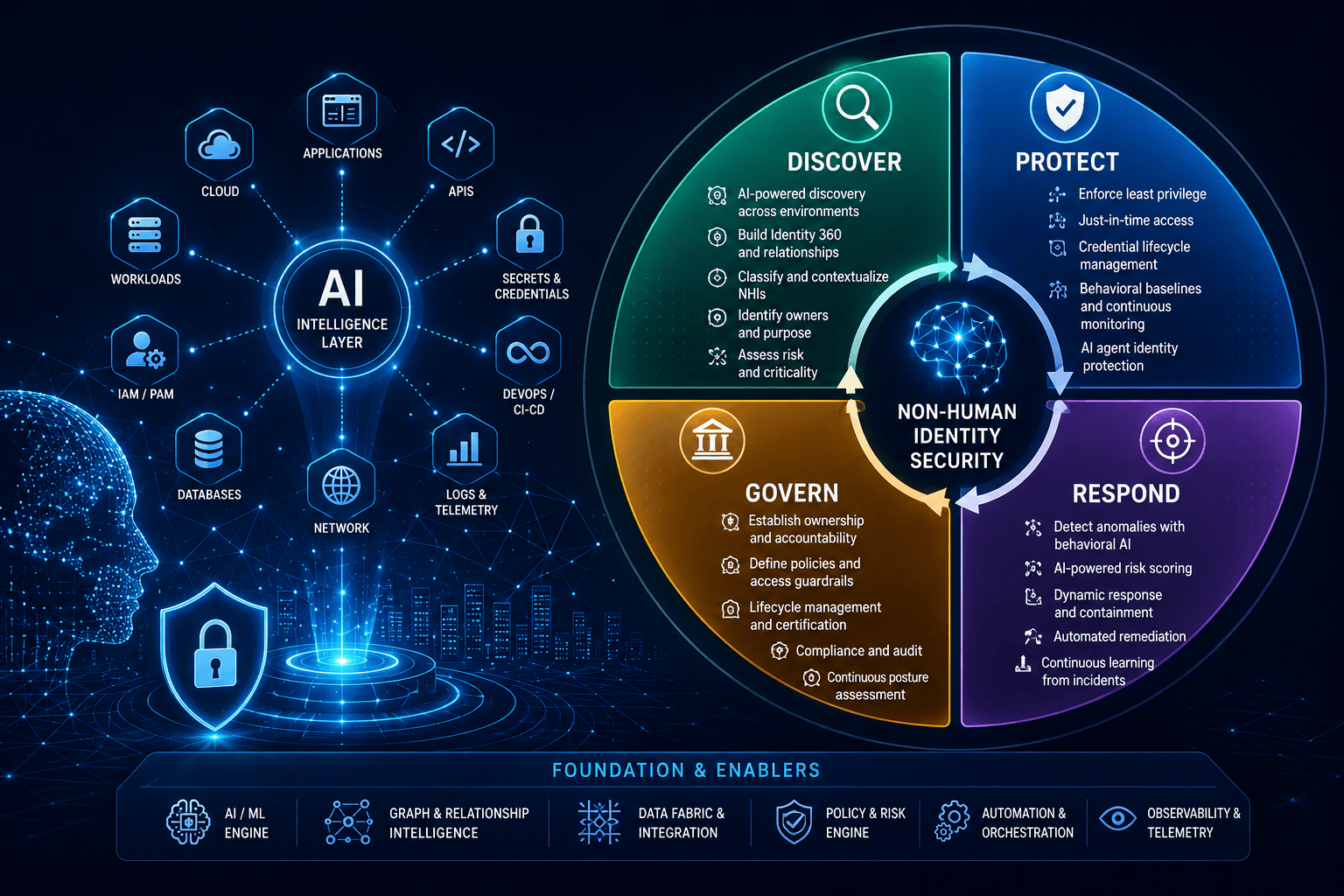
Step 1: NHI DISCOVER
Discovery tells us what exists and creates an NHI Inventory across the enterprise.
a.) AI Discovery of Sources
AI should continuously ingest signals from:
IAM | PAM | CI/CD | Cloud | Kubernetes | API Gateways | Secrets Managers | SIEM | EDR | Applications | Databases | Network | DevOps | AI Platforms
The objective extends beyond creating a simple inventory.
The aim is to establish a comprehensive Identity 360 view.
b.) Key AI Capability for Discovery
- Identity Entity Resolution
AI correlates fragmented signals to determine whether multiple credentials, accounts, applications, and workloads represent the same logical identity or application ecosystem, and to establish the relationships across NHIs and the resources that they are used against.
Step 2: NHI PROTECT
Protection reduces exposure. Protection should be based on least privilege, context, behavior, and risk.
This step helps to reduce NHI Risk before it becomes an incident.
a.) AI-Powered NHI Risk Scoring
Every NHI should receive a continuously evaluated risk score.
NHI Risk Score
- Risk = Privilege + Exposure + Sensitivity + Behavior + Criticality + Credential Risk + Ownership
b.) AI-Powered Least Privilege
AI can analyze historical behavior to determine:
What permissions does this identity actually need?
c.)AI-Powered Just-in-Time NHI Access
Standing privilege should be treated as an exception rather than the default configuration.
AI Agent dynamically determines whether access should be:
Allow → Step-up → Approve → Limit → Deny
d.) Protecting AI Agents
AI agents require an additional security layer.
Every enterprise AI agent should have:
Agent Identity + Owner + Purpose + Permissions + Tools + Data Scope + Risk Profile + Audit Trail
Step 3: NHI RESPOND
Response answers: What happens when an NHI becomes risky or compromised?
AI can continuously monitor NHI behavior and detect deviations from established behavioral baselines.
a.) AI-Powered Behavioral Intelligence
For each non-human identity (NHI), AI establishes a behavioral baseline:
- Who/what does it normally interact with?
- When does it operate?
- From where?
- What APIs does it call?
- What data does it access?
- How much data does it move?
- What permissions does it normally use?
b.) AI-Powered NHI Response
When risk increases, the system should dynamically determine the appropriate response.
Low Risk
Monitor → Alert → Increase telemetry
Medium Risk
Step-up verification → Reduce privilege → Increase monitoring.
High Risk
Suspend credential → Revoke token → Remove privilege → Isolate workload.
Critical Risk
Quarantine identity → Terminate sessions → Rotate credentials → Block downstream access → Initiate investigation.
This approach establishes an identity-aware autonomous response loop.
Step 4: NHI GOVERNANCE
This process is designed to establish continuous accountability.
Governance is what turns NHI security from a technical capability into an enterprise operating model.
For governance to be implemented, every NHI should have the following attributes.
- An Owner : Who is accountable?
- A Purpose : Why does the identity exist?
- A Business Context: What business process does it support?
- An Access Policy: What should it be allowed to do?
- A Risk Classification: How dangerous would compromise be?
- A Lifecycle: When should it be created, reviewed, rotated, and retired?
- Evidence: Can the organization prove that access is appropriate?
a.) AI-Powered Continuous Governance
Traditional governance often looks like:
→ Quarterly Access Review → Approve → Repeat
AI enables:
→ Continuous Monitoring → Continuous Risk Evaluation → Continuous Policy Validation → Continuous Remediation
AI can proactively identify:
- Orphaned identities
- Dormant identities
- Excessive permissions
- Unused credentials
- Expiring credentials
- Policy violations
- Unknown owners
- Unapproved AI agents
- Toxic access combinations
- Segregation-of-duties violations
- High-risk attack paths
Rather than relying on periodic reviews, governance becomes a continuous process.
Share this:

Posted on August 19, 2026, in Blog. Bookmark the permalink. Leave a comment.
Leave a comment
Comments 0