MCP + A2A: The Connectivity Layer for the Agentic Enterprise
A single intelligent agent will not define the next phase of enterprise AI.
Networks of specialized agents working together will define it.
A customer-service agent may need to ask a billing agent to investigate an invoice. A security agent may need to ask an identity agent to validate a user’s risk. A procurement agent may need to collaborate with a finance agent before approving a purchase.
And those agents may be built by different teams, run on different platforms, use different AI models, and access completely different enterprise systems.
This creates a fundamental architectural question:
How do AI agents connect to the enterprise—and how do they communicate with one another?
Two emerging open protocols provide an important part of the answer:
- Model Context Protocol (MCP) connects agents to tools, data, APIs, and resources.
- Agent2Agent (A2A) connects agents to other agents so they can discover capabilities, delegate work, collaborate, and exchange results.
The important insight is that MCP and A2A are not competing protocols. They solve two different layers of the connectivity problem.
Think of MCP as the agent-to-capability layer and A2A as the agent-to-agent collaboration layer.
Together, they provide a foundation for building an interoperable agentic enterprise.

What Is MCP?
The Model Context Protocol (MCP) provides a standardized way for AI applications and agents to interact with external tools, data, and resources.
Instead of having every agent implement a custom integration, an MCP server can expose its capabilities through a common protocol.
For example:

The agent doesn't need to understand every underlying implementation.
It discovers the available capabilities and invokes them through MCP.
The latest MCP specification, released July 28, 2026, has also moved toward a more scalable architecture, including a stateless protocol core, routable HTTP-based interactions, cacheable capability discovery, authorization hardening, and an extensions framework.
That evolution is important because enterprise agent architectures need to operate at much larger scale than the original local-tool use cases.
What Is A2A?
The Agent2Agent (A2A) Protocol is an open standard that enables independent AI agents to communicate and collaborate.
A2A allows agents built using different frameworks, languages, technologies, or vendors to discover capabilities, negotiate interactions, manage tasks, and exchange information without requiring access to each other’s internal state, memory, or tools.
This distinction is critical.
An agent doesn’t necessarily expose its internal reasoning or implementation.
Instead, it exposes a capability boundary.
For example:
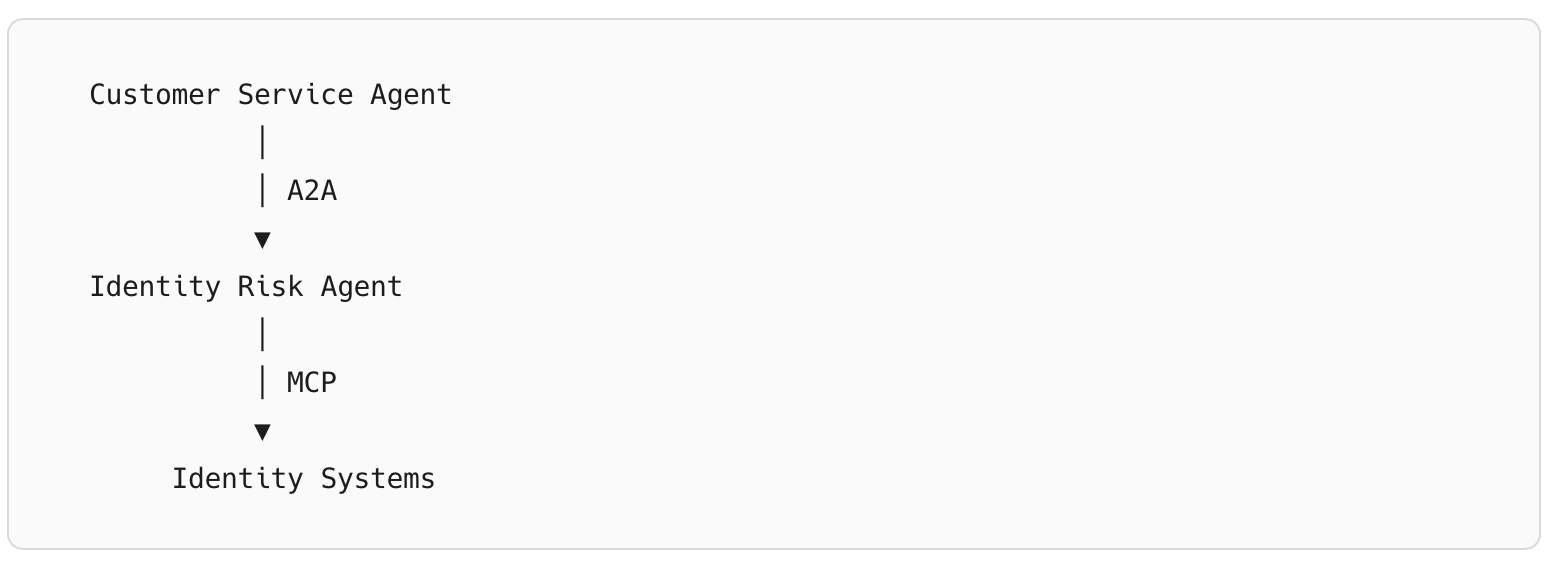
The customer service agent doesn’t need to know how the identity agent works.
It only needs to know:
- What can you do?
- What information do you need?
- What task can you perform?
- What result can you return?
That is the essence of agent interoperability.
MCP vs. A2A
The easiest way to understand the difference is:
| Question | MCP | Agent |
| Typical interaction | Tool invocation | Task delegation |
| Example | Agent → CRM API | Agent → Identity Agent |
| Discovery | Tools/resources | Agent capabilities |
| Result | Structured tool output | Task/result exchange |
| Boundary | Capability boundary | Agent boundary |
The official A2A documentation describes the protocols as complementary: MCP connects agents to tools and resources, while A2A enables agents to collaborate.
How MCP and A2A Work Together
This is where the architecture becomes particularly powerful.
Imagine an enterprise security investigation.
A Security Orchestrator Agent receives:
“Investigate whether this user’s recent privileged-access activity represents a security threat.”
The orchestrator may not perform the entire investigation itself.
Instead:
Step 1 — A2A discovers specialized agents
The orchestrator discovers:
- Identity Risk Agent
- Privileged Access Agent
- Endpoint Security Agent
- Threat Intelligence Agent
Step 2 — A2A delegates tasks

Step 3 — Each agent uses MCP
The Identity Agent might use MCP to access:

The PAM Agent might use:

The Endpoint Agent might use:

The individual agents then return their findings through A2A.
The orchestrator combines those results and makes a decision.
The Emerging Enterprise Agent Architecture through MCP + A2A
This leads to a much more scalable architecture:

This creates two distinct connectivity layers:
1. Horizontal connectivity = A2A
- Agents collaborate with other agents.
2. Vertical connectivity = MCP
- Agents connect to enterprise capabilities.
Share this:

Posted on August 27, 2026, in AI, Blog. Bookmark the permalink. Leave a comment.
Leave a comment
Comments 0