How Governance Around Identity and Access Is Changing in 2026
For decades, enterprise identity management was primarily viewed as a perimeter issue. The main objective was to verify that an employee or customer was who they claimed to be at the initial point of entry, issue a password or single sign-on (SSO) token, and grant access accordingly. Enterprise security was grounded in a foundational question: “Who are you, and what systems are you allowed to access?”
By 2026, this approach has become obsolete, and the traditional questions are no longer adequate for effective identity governance.
The proliferation of distributed multi-cloud architectures, non-human identities, and autonomous AI agents capable of executing thousands of actions per minute has created an unprecedented paradigm shift for security leaders. As a result, traditional Identity Governance and Administration (IGA) is rapidly evolving into Identity, Authorization, and Runtime Governance.
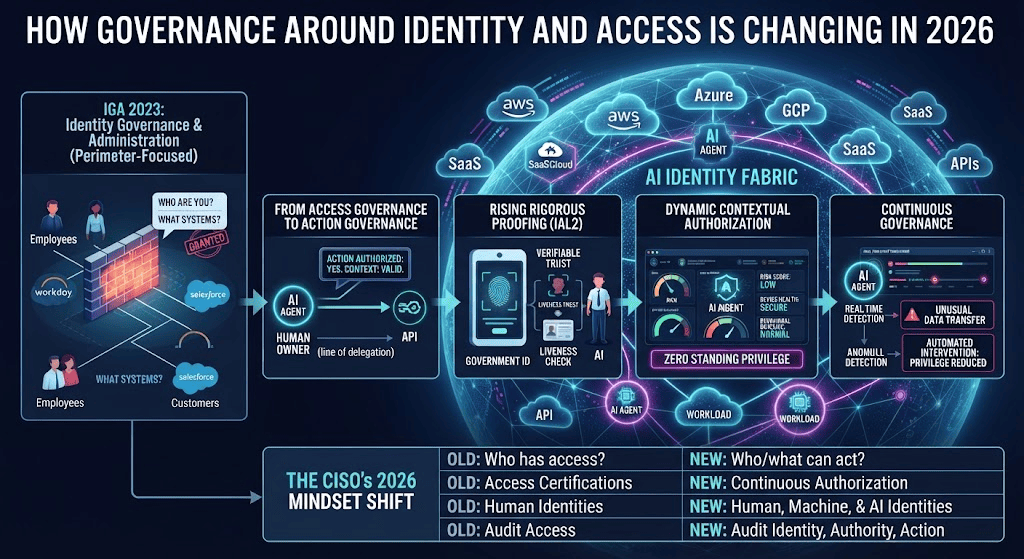
The following analysis examines how governance surrounding identity and access is undergoing fundamental transformation.
1. From Access Governance to Action Governance
Traditional IGA models governed static access paths (e.g., Jane, a Finance Manager, has access to Salesforce, Workday).
In 2026, security teams are required to govern actions rather than merely access. When an AI agent leverages delegated authority to interact with an API or update numerous accounts, the critical question extends beyond system access to whether the agent is authorized to perform specific actions on behalf of a human. As highlighted in NIST’s 2026 guidance, reliance on extensive human-in-the-loop controls or the sharing of broad credentials introduces significant risks within agentic systems.
2. Managing the Explosion of AI Agents and Non-Human Identities
Whereas previous governance models focused primarily on employees, contractors, and partners, contemporary enterprises now manage an expanding ecosystem that includes service accounts, APIs, cloud workloads, and AI agents.
Modern enterprises are no longer comprised solely of human workers. In many cloud environments, autonomous AI agents, service accounts, APIs, and automated pipelines now outnumber human users.
Traditional Identity and Access Management (IAM) tools were designed to manage human login lifecycles, resulting in significant governance gaps for non-human entities. By 2026, organizations must address the reality that AI agents or automated scripts with broad permissions can execute high-impact actions at machine speed. As a result, governance frameworks have expanded to treat non-human actors as first-class entities, requiring explicit lifecycle oversight, verifiable lineage, and stringent runtime boundaries.
In contrast to traditional service accounts that execute predefined scripts, AI agents interpret objectives, select tools, make decisions, and delegate tasks to sub-agents. In alignment with NIST’s 2026 AI Agent Standards Initiative, governance of non-human identities is becoming a core enterprise requirement, necessitating:
- A verifiable, unique identity and defined purpose
- An accountable human owner
- Clear traceability through a delegation chain
- Defined lifecycle management (from creation to retirement)
3. Moving Beyond the Front Door: The Rise of Rigorous Proofing (IAL2)
The proliferation of deepfakes, synthetic data, and automated credential stuffing has rendered basic logins increasingly untrustworthy. Consequently, organizations are raising their upfront verification standards. Frameworks such as NIST’s Identity Assurance Level 2 (IAL2) are transitioning from federal mandates to mainstream enterprise requirements.
Contemporary governance frameworks now distinguish between identity proofing (“Who are you in the real world?”) and authentication (“Do you control this digital credential?”). Organizations are implementing multi-pathway proofing processes that integrate government-issued photo validation, biometric liveness checks, and authoritative database cross-checks. These measures ensure that every high-risk digital interaction or privileged onboarding is anchored in verifiable trust prior to the issuance of any token.
4. Transitioning to Dynamic, Contextual Authorization
Static Role-Based Access Control (RBAC) and once-per-session checks are no longer sufficient to protect dynamic cloud architectures. Modern frameworks are adopting models that emphasize Just-in-Time, Just Enough Access, and action-specific authorization to address the demands of real-time environments.
Authorization engines now incorporate real-time context and risk, evaluating variables such as user behavior, device state, agent intent, environmental factors, and continuous risk scores prior to granting transaction-level privileges.
Current market trends emphasize continuous authorization and Zero Standing Privilege (ZSP). Identity governance systems now evaluate context in real time by analyzing device health, network anomalies, behavioral baselines, and runtime risk scores. If an entity’s risk profile changes during a session, governance platforms can automatically increase verification requirements, restrict permissions, or terminate access immediately.
5. Moving from Periodic Reviews to Continuous Governance
Quarterly access reviews and annual certifications are insufficient for environments operating at machine speed. Governance is transitioning from periodic audits to continuous, real-time, and event-driven monitoring. If an agent’s behavior becomes anomalous, policies can trigger immediate automated interventions to reduce privileges.
6. Convergence Into an “Identity Control Plane” and The Shift Toward the “AI Identity Fabric”
Historically, technologies such as IGA, Privileged Access Management (PAM), Security Information and Event Management (SIEM), and User and Entity Behavior Analytics (UEBA) operated in isolated silos. The emergence of AI is driving the convergence of these technologies into a unified Identity Control Plane, which serves as a centralized framework for organizations to discover, assess, authorize, and govern all digital actions across multicloud and SaaS environments.
To integrate these components, enterprise architecture is evolving toward an AI Identity Fabric.
Future IAM platforms will extend beyond managing human users to governing the complex relationships among humans, AI agents, tools, data, and autonomous actions. Each automated workflow must maintain a clear and traceable chain of delegation, linking every autonomous action to an accountable human sponsor.
What This Means for Identity Leaders
For Chief Information Security Officers (CISOs) and Chief Information Officers (CIOs), the operational mindset is experiencing a fundamental transformation:
- Old Priority: “Who has access?” → New Priority: “Who or what can act?”
- Old Priority: Access certifications → New Priority: Continuous authorization
- Old Priority: Human identities → New Priority: Human, machine, and AI identities
- Old Priority: Audit access → New Priority: Audit identity, authority, and action
Conclusion
Enterprises in 2026 differ fundamentally from those for which traditional IGA was designed. The transformation of identity governance extends well beyond a product update; it signifies a shift from managing access to managing authority. Identity is increasingly serving as the mechanism by which enterprises govern digital actions.
By establishing identity as the core control plane for autonomous enterprises, organizations can securely leverage AI while ensuring that every human, machine, and autonomous agent operates with verifiable intent and accountability. Organizations that persist in treating identity as an isolated login mechanism will face challenges from automated threats and stringent compliance audits. Success will favor those who adopt identity as an observable, programmable, and deeply integrated infrastructure fabric.
Share this:

Posted on September 3, 2026, in AI, Blog, Digital Transformation, IAM, Market Trends. Bookmark the permalink. Leave a comment.
Leave a comment
Comments 0