Transitioning to Identity as a Signal: IAL2 Explained
Most organizations treat identity proofing as a one-time gate: collect a document, run a selfie match, mint an account, move on. But NIST’s Identity Assurance Level 2 (IAL2) serves as the sweet spot between low-friction onboarding and high-assurance risk mitigation.
But the benefits of Identity verification are becoming important for the following reasons.
Key Drivers
- Combating Advanced Fraud: IAL2 directly counters synthetic identity creation, stolen credentials, and account takeover (ATO) attacks during onboarding.
- Regulatory Compliance: Essential for adhering to Know Your Customer (KYC), Anti-Money Laundering (AML), and NIST/Federal compliance frameworks in finance, healthcare, and government digital services.
- Zero Trust Security: Organizations must establish verifiable digital trust before granting access to high-privilege applications or sensitive data.
Implementing IAL2 verification requires balancing security with user experience.
The New Identity Security Paradigm
The shift from traditional IAM to Intelligent Identity Security means moving away from “Identity as a Record” toward “Identity as a Signal.”
IAL2 provides the necessary foundation for a true Zero Trust architecture by ensuring that the person behind the device is verified, real, and currently living.
By integrating multi-pathway verification, recording provenance, and closing the recovery loop, organizations can transition from a one-time gate to a continuously governed trust lifecycle.
Is your organization’s identity foundation built on a one-time gate, or a continuously governed trust lifecycle?
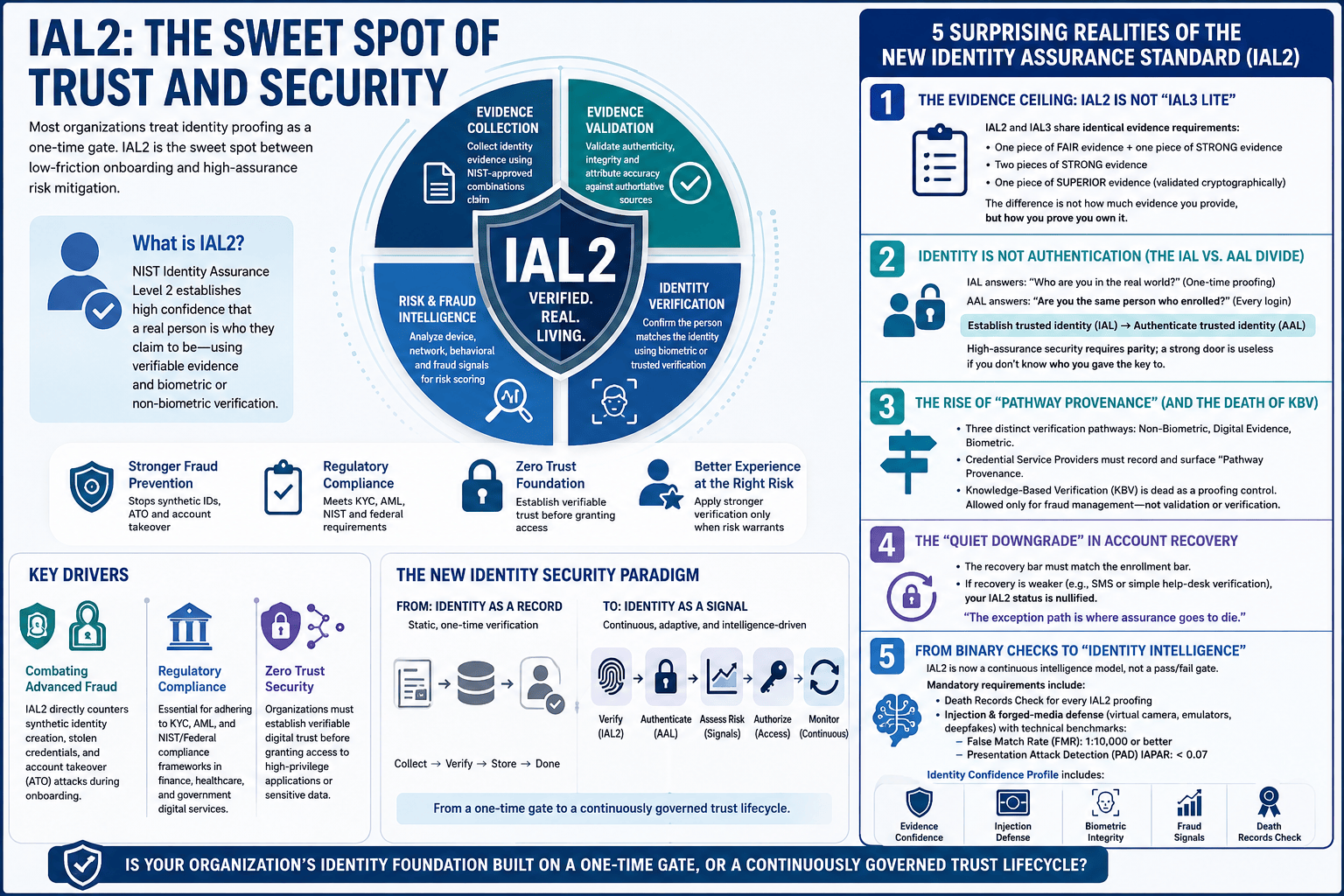
5 Surprising Realities of the New Identity Assurance Standard (IAL2)
The 2017 identity guidelines that governed the last decade of digital growth are officially obsolete. With the July 2025 release of NIST SP 800-63A-4, the “good enough” approach to identity relying on stolen passwords, compromised mobile numbers, and easily spoofed “out-of-wallet” questions has moved from a security risk to a massive organizational liability.
As synthetic identities and AI-generated deepfakes flood onboarding queues, NIST Revision 4 introduces a fundamental shift in establishing trust.
At the heart of this evolution is Identity Assurance Level 2 (IAL2).
No longer just a checklist for a selfie and a driver’s license, IAL2 is now the mandatory foundational trust layer for any high-risk digital interaction.
To navigate this new era, executives and architects must look past the interface and understand five surprising technical and strategic realities of the modern standard.
1. The Evidence Ceiling: IAL2 is Not “IAL3 Lite”
The most persistent myth in identity architecture is that IAL3 requires more documentation than IAL2. It doesn’t.
Under Revision 4, IAL2 and IAL3 share identical evidence collection requirements. To reach either level, you must collect one of three combinations:
- One piece of FAIR evidence plus one piece of STRONG evidence.
- Two pieces of STRONG evidence.
- One piece of SUPERIOR evidence (validated cryptographically).
The difference is not how much evidence you provide but how you prove you own it.
IAL3 is strictly “on-site attended,” whereas IAL2 provides the flexibility to mix modalities, including remote, on-site, attended, or unattended pathways.
If you have built an IAL2 process that validates a passport and a driver’s license, you have already hit the “evidence ceiling.”
2. Identity is Not Authentication (The IAL vs. AAL Divide)
A common architectural failure is bundling identity and authentication. NIST Revision 4 enforces a strict divide between them because they solve fundamentally different problems:
- Identity Assurance Level (IAL): “Who are you in the real world?” This is a one-time or periodic proofing event.
- Authentication Assurance Level (AAL): “Are you the same person who enrolled?” This happens at every login.
The strategic flow is: Establish trusted identity (IAL) → Authenticate trusted identity (AAL).
You can have a high-security passkey (AAL3) protecting an account that was never actually verified (IAL1). Conversely, you can prove an employee at IAL2 but allow them to authenticate with a weak SMS code (AAL1).
High-assurance security requires parity; a strong door is useless if you don’t know who you gave the key to.
3. The Rise of “Pathway Provenance” (and the Death of KBV)
In Revision 4, “IAL2” is no longer a monolithic status. There are now three distinct verification pathways:
- Non-Biometric: Verification via a mailed confirmation code or visual comparison by a trained agent.
- Digital Evidence: High-assurance federation or wallet credentials (e.g., mDL or bank account linking).
- Biometric: Automated comparison of a live sample against a validated document.
The Surprising Shift: Credential Service Providers (CSPs) now have a normative obligation to record and surface “Pathway Provenance.” It is no longer enough to assert that a user is IAL2; Relying Parties are entitled to know how that level was reached.
Furthermore, Knowledge-Based Verification (KBV) is officially dead as a proofing control. Revision 4 permits KBV only for fraud management—not for validation or verification. If your flow still relies on “your first car” questions to prove identity, you are not compliant with IAL2.
4. The “Quiet Downgrade” in Account Recovery
The “Achilles’ heel” of modern security is the exception path. You might spend thousands to prove a user at IAL2 during onboarding, only to have a help desk agent reset their credentials after a low-assurance phone call.
When the recovery path is weaker than the enrollment path, the original IAL2 status is effectively nullified. Revision 4 mandates that the recovery bar must match the enrollment bar.
“The exception path is where assurance goes to die.”
If your account recovery relies on a “quiet downgrade” to SMS or simple help-desk verification, your system’s actual assurance level matches the strength of that recovery path, not the high bar of onboarding you paid for.
5. From Binary Checks to “Identity Intelligence”
IAL2 has evolved from a point-in-time “pass/fail” gate into a continuous Identity Intelligence model. Modern compliance requires technical controls that go beyond simple document scanning.
Two mandatory requirements of Revision 4 often surprise organizations:
- Death Records Check: A mandatory check against authoritative death records is now required for every IAL2 proofing process.
- Injection and Forged-Media Defense: You must implement technical controls to detect virtual cameras, emulators, and deepfakes. This includes testing your algorithms against known attack artifacts to establish baseline false-positive rates.
To assert IAL2 conformance for the Biometric Pathway, you must meet specific technical benchmarks: a False Match Rate (FMR) of 1:10,000 or better and a Presentation Attack Detection (PAD) threshold with an IAPAR below 0.07.
The Identity Confidence Profile now includes:
- Evidence Confidence: Validating security features and authoritative sources.
- Injection Defense: Confirming media originates from a genuine sensor.
- Biometric Integrity: Testing against ISO/IEC 30107-3 standards for liveness.
- Fraud Signals: SIM swap detection, device reputation, and mandatory death record checks.
Share this:

Posted on August 24, 2026, in Blog, IAM, Market Trends. Bookmark the permalink. Leave a comment.
Leave a comment
Comments 0